
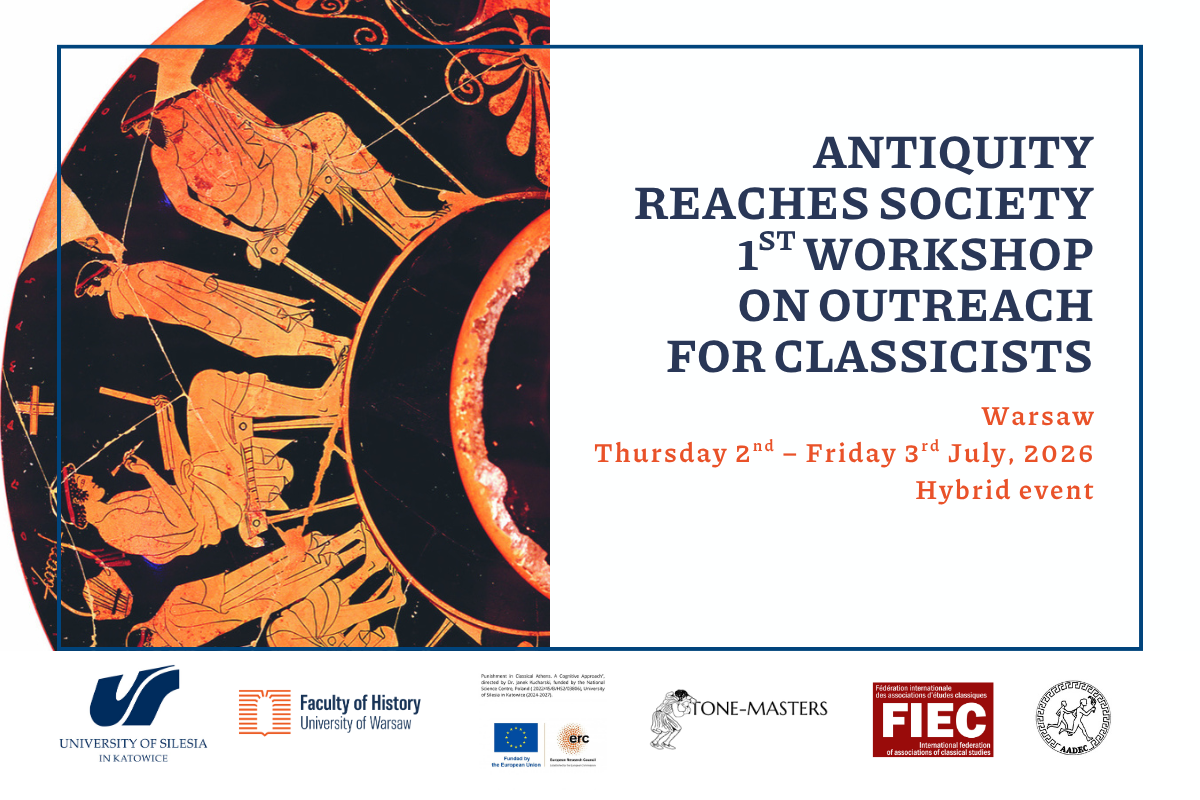
Workshop – Thursday 2nd – Friday 3rd July, 2026
The world is currently undergoing a period of rapid and profound change. The rapid emergence of technological advances in everyday life has fostered the expectation of immediate, tangible (often economic) results in every aspect of our lives. This acceleration is further amplified by the rise of artificial intelligence, where access to knowledge seems to be only one click away. Nevertheless, this whole process has raised doubts regarding how knowledge is created and disseminated. While this trend affects society at large, it seems to be more evident among the younger generations. Yet reflection, communication skills, and the effort required to interpret and understand texts remain essential for living together in a democratic society.
Traditionally, these skills have been developed within the framework of the humanistic disciplines: history, philosophy, literature, etc., and among them, classical studies and the study of antiquity have traditionally occupied a prominent role, both in secondary education and at the university. However, over the last few decades, classical studies have been relegated to a small niche within higher education and are sometimes regarded by policymakers or even other academics as expendable, outdated, or elitist. This bias is also mirrored by society at large, which continues to view academics as isolated individuals working in an “ivory tower”. This lack of connection with society has been recognised by some academics who believe that including novel perspectives, such as gender studies or decolonial or postcolonial studies, is merely a timid attempt at updating the field (e.g., Umachandran & Ward, 2024). Therefore, the rapid technological advances and the socio-political changes the world has endured within the last thirty years have led academia to question what its function is to society.
Despite the many advantages and skills the Humanities and, particularly Classical Studies among them, offer to society, these fields end up losing support for their continued presence in university curricula (something that has been made explicit with the discontinuation of BA, MA, and PhD programmes in different universities around the world). As classicists, we are ultimately confronted with a Gordian knot that we cannot seem to unbind. Part of the solution, however, may lie in improving communication and fostering a more open engagement with society.
This workshop aims to address this challenge in a practical and hands-on way: combining specific training with the exchange of personal experiences in outreach across diverse social contexts. Its main objective is to offer classicists concrete tools for the improvement of the way they communicate their results beyond academia. This entails thinking of them as agents of change in both the social and academic spheres. Therefore, the proposed activities seek to foster a reflective non-hierarchical dialogue between all the participants, in which the interaction between the proposed tools and the specificity of classical studies is central.
The workshop will include three types of activities: plenary lectures by guest speakers; training courses offered by specialists focusing on communication between academics and policymakers, working with young children and teenagers, and plain language, as well as panels on shared experiences by the participants.
Online registration is necessary: Day 1; Day 2
Organised by: Mariana Franco San Román, Marina Bastero Acha, Janek Kucharski, Paweł Nowakowski