
Seminarium Historii Gender – 16 czerwca 2026 r.
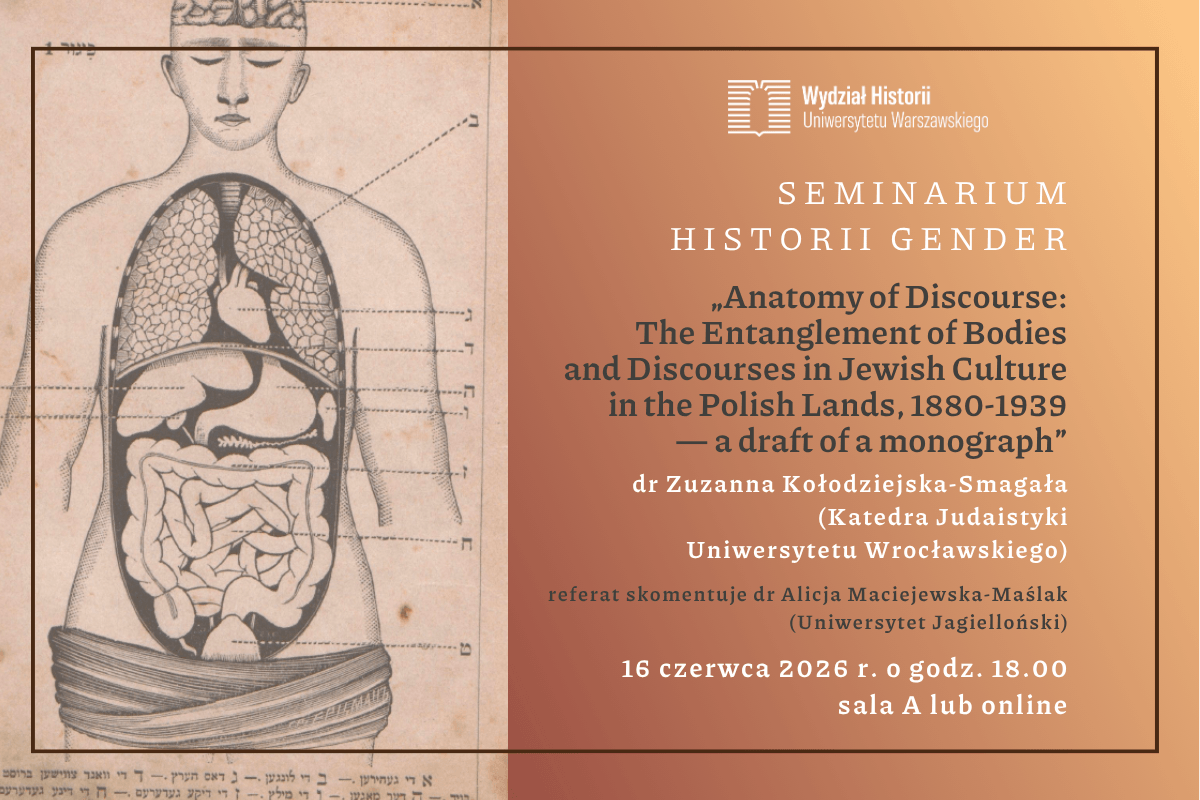
Serdecznie zapraszamy na czerwcowe spotkanie Seminarium Historii Gender, organizowane przez prof. Dobrochnę Kałwę, podczas którego dr Zuzanna Kołodziejska-Smagała (Katedra Judaistyki Uniwersytetu Wrocławskiego) wygłosi w języku angielskim referat pt. „Anatomy of Discourse: The Entanglement of Bodies and Discourses in Jewish Culture in the Polish Lands, 1880-1939 — a draft of a monograph”. Spotkanie skomentuje dr Alicja Maciejewska-Maślak (Uniwersytet Jagielloński).
Spotkanie odbędzie się 16 czerwca 2026 r. (wtorek) o godz. 18:00 na Wydziale Historii (Budynek Pomuzealny) w sali A oraz online.
Link do spotkania online można uzyskać, kontaktując się e-mailowo pod adresem historia.gender@uw.edu.pl
 |
Zuzanna Kołodziejska-Smagała jest literaturoznawczynią, której zainteresowania naukowe koncentrują się wokół dziewiętnastowiecznej literatury i prasy polsko- żydowskiej. Interesują ją granice kulturowe, wczesny feminizm, cielesność, postrzeganie płci kulturowej i nieoczywiste relacje między żydowskimi i nieżydowskimi aktorami społecznymi na przełomie XIX i XX wieku.
Kierowniczka różnych projektów dotyczących polsko-żydowskiego pogranicza. Na Uniwersytecie Jagiellońskim realizowała projekt o polsko-żydowskiej literaturze z lat 1861-1918, czego rezultatem były dwie książkowe publikacje: antologia (Literatura polsko-żydowska 1861-1918. Antologia, Kraków 2017) oraz zbiór artykułów dotyczących różnych zjawisk obecnych w badanej literaturze (Literatura polsko- żydowska 1861-1918. Studia i szkice, Kraków 2018). Natomiast na Uniwersytecie Warszawskim kierowała projektem o dyskursach o cielesności i seksualności w polsko-żydowskim piśmiennictwie kobiecym z lat 1890-1918, czego rezultatem były artykuły naukowe oraz obecny projekt, Dyskursy o ciele w kulturze żydowskiej na ziemiach polskich w latach 1880 —1939, finansowany przez Narodowe Centrum Nauki w ramach programu Opus, nr 2022/47/B/HS2/01522. Strona projektu: https://corporeality.uwr.edu.pl/start_en |
Wprowadzenie do wystąpienia:
Zuzanna Kołodziejska-Smagała would like to present and discuss her first draft of a book proposal that is going to be a monograph devoted to the issue of discourses on body in Jewish culture in the Polish lands between 1880-1939, which is an effect of research project that she is currently leading at the Taube Department of Jewish Studies, University of Wroclaw, funded by the NCN. The monograph is supplemented by the anthology of sources that her team is currently working on.
The objective of the research is to examine the nature of changes in discourses on body among Jews who lived in the lands of former Polish-Lithuanian Commonwealth and then Second Polish Republic. It is not going to be a detailed monograph, but rather a bird-eye-view on various categories or fields of social activities that can be analysed from the perspective of discourses on body. It will present methodology and provide a reader with some case studies, while simultaneously it is aimed to show the potential of discourses on body as a perspective enabling examination of human networks, flows of ideas, and social history in a broad transregional and transcultural context.
The analysed textual sources, that include ego-documents, literature, press, political pamphlets, state documents, and others, are in five languages: Yiddish, Hebrew, Polish, Russian, and German, because these were the languages that Jews living in the analysed region used. Yet, what is extremely important is their different functions: Yiddish and Hebrew are internal languages, but their social function is different, and their use is gender-specific. Russian and German are the languages of state authorities in Prussia and in the Habsburg Empire, but they also perform a particular function inside the Jewish community, as they are related to the issue of assimilation. Finally, Polish is the language of the state authority after 1918, it is also a language of school instructions in the Habsburg Empire, and it is the language of cultural aspiration for some members of Jewish elites in the Kingdom of Poland. The functions of these languages fluctuated in the analysed period, which is also important. The aim of the project has been to analyse Jewish society as versatile as possible, thus the languages function also as markers of social status, class, congregation, political or ideological views of the user. The hypothesis is that due to a multilingual character of Jewish culture, as well as the bigger mobility of Jews than of non-Jews, Jewish social actors performed a function of transmitters of new ideas between different parts of Europe and the US. The verification of that hypothesis is done by the examination of discourses on body, because in the analysed period the human body became a notion that influenced practically every sphere of human activities.
Another important notion in the analysis is modernisation and modernism, because Jews and non-Jews alike were undergoing a rapid modernisation process. The proposed monograph is aimed to show those complex relations, links and influence of different body-related discourses not only on culture, but also on social practice, thus ego-documents play here a role of limited, yet still, litmus test for those changes in perception of body, showing the extent to which discourses produced by elites influenced everyday life. She believes that this monograph and the research can also prove that Jewish social and cultural history is not a separate subfield of social and cultural history of a Jewish minority that lived in the Polish lands, but it is a crucial element of social and cultural history of Poland.